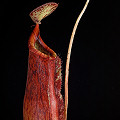
 Nepenthes ×superba
(lower pitcher) Nepenthes ×superba
(upper pitcher)
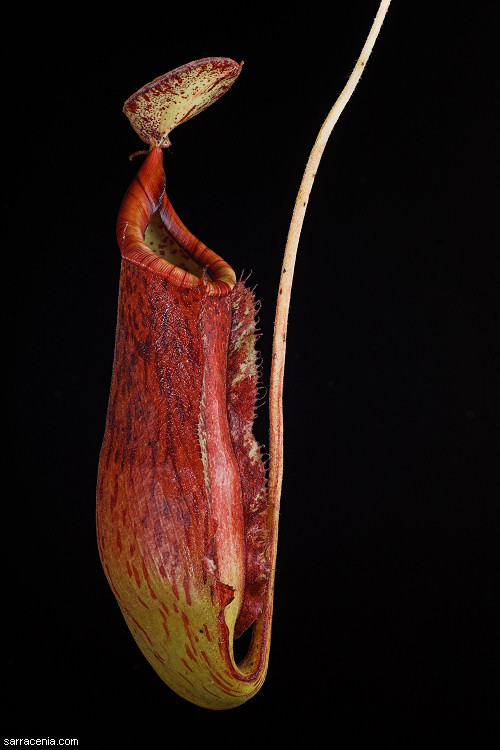
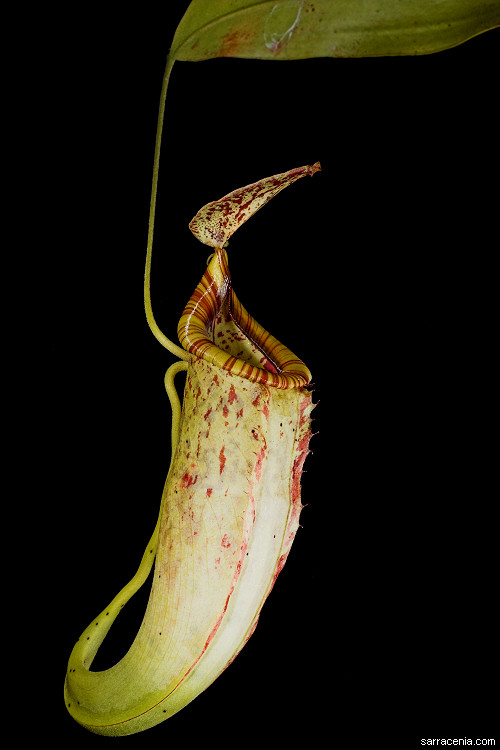
So, you have a Nepenthes, huh? Not quite my recommendation as a first carnivorous plant for the beginner to try. The challenge is that these plants can be really big, and so require really large growing areas. They don't usually tuck into a small terrarium very conveniently.
Let me suppose that you bought a small plant. By small, I mean a plant that occupies about as much area as your hand, with your fingers splayed. In this case, growing the plant is pretty easy. Unlike most carnivorous plants, Nepenthes do not require super bright light. So it might actually survive on a very bright windowsill. But it does like the light it would get from a bright terrarium, so don't hesitate to consider rigging up a carnivorous plant terrarium as I describe elsewhere in the FAQ. Even a bottle terrarium will be helpful if your plant is small enough.
Nepenthes plants do not like to be sitting in water, so put your little potted plant in a shallow saucer and water it every day or so---however often you find it necessary to keep the potting medium moist. If you keep it sitting in water, the root system will become dwarfed (at least for most species) and the plant will be small in general. They like conditions humid and warm. Never give them a winter dormancy, as they are tropical plants that grow year-round. If you must transplant them, put them in a mix like 50:50 Sphagnum:perlite.
Nepenthes like very high humidity, around 70-100%, so you'll need to keep it in some kind of humidity enclosure like one of the terrarium options I mentioned above.
If, for some fool reason, you have yourself a very large plant, you're going to have a devil of a time finding a place you can keep it. It will need lots of light, and plenty of humidity. Follow the same guidelines as for small plants---don't let it sit in water, but keep the soil moist. How you're going to achieve all this in a conventional house, I don't know. You really need a greenhouse.
If you try growing Nepenthes, but don't do it very well, the plant will probably survive fairly well, but might just look like a lanky vine. The pitchers the plant had when you bought it will eventually die, and the new leaves that form won't make replacement pitchers. This is very frustrating, I know. What must you do to have a plant make pitchers? Just grow the dang thing better. Pitcherless leaves, by itself, is such a general symptom that it can't be used to diagnose exactly what you're doing wrong.
If you have a Nepenthes plant and really want it to grow, I recommend you buy a book like D'Amato. That will cover all the extra stuff like fertilizing, propagation, etc.
Finally, if for some reason you have a hair up your bum to grow Nepenthes rajah as your first plant, take a pill or something. This is a very expensive plant with particular needs, and is suitable only for the expert.
Let me suppose that you bought a small plant. By small, I mean a plant that occupies about as much area as your hand, with your fingers splayed. In this case, growing the plant is pretty easy. Unlike most carnivorous plants, Nepenthes do not require super bright light. So it might actually survive on a very bright windowsill. But it does like the light it would get from a bright terrarium, so don't hesitate to consider rigging up a carnivorous plant terrarium as I describe elsewhere in the FAQ. Even a bottle terrarium will be helpful if your plant is small enough.
Nepenthes plants do not like to be sitting in water, so put your little potted plant in a shallow saucer and water it every day or so---however often you find it necessary to keep the potting medium moist. If you keep it sitting in water, the root system will become dwarfed (at least for most species) and the plant will be small in general. They like conditions humid and warm. Never give them a winter dormancy, as they are tropical plants that grow year-round. If you must transplant them, put them in a mix like 50:50 Sphagnum:perlite.
Nepenthes like very high humidity, around 70-100%, so you'll need to keep it in some kind of humidity enclosure like one of the terrarium options I mentioned above.
If, for some fool reason, you have yourself a very large plant, you're going to have a devil of a time finding a place you can keep it. It will need lots of light, and plenty of humidity. Follow the same guidelines as for small plants---don't let it sit in water, but keep the soil moist. How you're going to achieve all this in a conventional house, I don't know. You really need a greenhouse.
If you try growing Nepenthes, but don't do it very well, the plant will probably survive fairly well, but might just look like a lanky vine. The pitchers the plant had when you bought it will eventually die, and the new leaves that form won't make replacement pitchers. This is very frustrating, I know. What must you do to have a plant make pitchers? Just grow the dang thing better. Pitcherless leaves, by itself, is such a general symptom that it can't be used to diagnose exactly what you're doing wrong.
If you have a Nepenthes plant and really want it to grow, I recommend you buy a book like D'Amato. That will cover all the extra stuff like fertilizing, propagation, etc.
Finally, if for some reason you have a hair up your bum to grow Nepenthes rajah as your first plant, take a pill or something. This is a very expensive plant with particular needs, and is suitable only for the expert.